What Is the Art of Repairing Pottery With Gold

Repair work (right) on Mishima ware hakeme -type tea bowl with kintsugi gold lacquer, 16th century
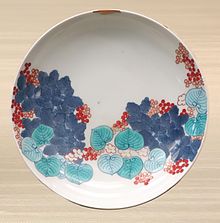
Kintsugi ( 金継ぎ , "golden joinery"), as well known as kintsukuroi ( 金繕い , "gilded repair"),[1] is the Japanese fine art of repairing broken pottery by mending the areas of breakage with lacquer dusted or mixed with powdered golden, silver, or platinum; the method is similar to the maki-due east technique.[2] [iii] [4] As a philosophy, it treats breakage and repair every bit part of the history of an object, rather than something to disguise.[v]
Origin [edit]
Lacquerware is a longstanding tradition in Nihon[6] [7] and, at some indicate, kintsugi may have been combined with maki-east as a replacement for other ceramic repair techniques. While the process is associated with Japanese craftsmen, the technique was too applied to ceramic pieces of other origins including Mainland china, Vietnam, and Korea.[8]
Kintsugi became closely associated with ceramic vessels used for chanoyu (Japanese tea ceremony).[three] One theory is that kintsugi may have originated when Japanese shōgun Ashikaga Yoshimasa sent a damaged Chinese tea basin dorsum to People's republic of china for repairs in the late 15th century. When information technology was returned, repaired with ugly metal staples, it may have prompted Japanese craftsmen to look for a more aesthetically pleasing means of repair.[9] Collectors became and then enamored of the new art that some were defendant of deliberately cracking valuable pottery and then it could be repaired with the golden seams of kintsugi . [ii] Information technology is also possible that a pottery piece was chosen for deformities it had acquired during production, and so deliberately broken and repaired, instead of being trashed. [two] On the other hand, according to Bakōhan Saōki (tape of tea-bowl with a 'large-locust' clamp), such "ugliness" was considered inspirational and Zen-like, as it connoted beauty in cleaved things. The basin became valued even more highly because of these large metal staples, which looked like a locust, and the basin was named 'bakōhan ("large-locust clamp").[10]
Philosophy [edit]
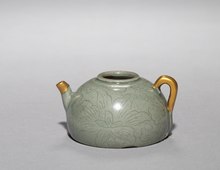
Goryeo vino ewer with golden lacquer repair. It was repaired by a Japanese collector in the early 20th century.
Equally a philosophy, kintsugi is like to the Japanese philosophy of wabi-sabi , an embracing of the flawed or imperfect.[11] [12] Japanese aesthetics values marks of article of clothing from the use of an object. This tin can exist seen equally a rationale for keeping an object around even after information technology has cleaved; it can also exist understood as a justification of kintsugi itself, highlighting cracks and repairs every bit events in the life of an object, rather than allowing its service to stop at the fourth dimension of its harm or breakage. The philosophy of kintsugi can also be seen as a variant of the aphorism, "Waste non, want not".[13]
Kintsugi can chronicle to the Japanese philosophy of mushin ( 無心 , "no mind"), which encompasses the concepts of non-zipper, acceptance of change, and fate as aspects of human life.[fourteen]
Not just is there no attempt to hibernate the damage, but the repair is literally illuminated... a kind of physical expression of the spirit of mushin....Mushin is often literally translated every bit "no mind," simply carries connotations of fully existing within the moment, of not-attachment, of equanimity among irresolute conditions. ...The vicissitudes of existence over fourth dimension, to which all humans are susceptible, could not be clearer than in the breaks, the knocks, and the shattering to which ceramic ware too is subject. This poignancy or aesthetic of existence has been known in Japan as mono no aware, a compassionate sensitivity, or possibly identification with, [things] outside oneself.
—Christy Bartlett, Flickwerk: The Aesthetics of Mended Japanese Ceramics
Types of joinery [edit]
There are a few major styles or types of kintsugi :
- Crack ( ひび ), the employ of golden dust and resin or lacquer to attach broken pieces with minimal overlap or make full-in from missing pieces
- Piece method ( 欠けの金継ぎ例 ), where a replacement ceramic fragment is not available and the entirety of the addition is gold or gilded/lacquer compound
- Joint telephone call ( 呼び継ぎ ), where a similarly shaped merely non-matching fragment is used to supercede a missing piece from the original vessel creating a patchwork result[xv]
[edit]

Nanking reticulated basket, c. 1750, mended with metallic staples
Staple repair is a similar technique used to repair broken ceramic pieces,[16] where small-scale holes are drilled on either side of a crack and metal staples are bent to hold the pieces together.[17] Staple repair was used in Europe (in aboriginal Hellenic republic, England and Russian federation amidst others) and China equally a repair technique for especially valuable pieces.[17]
Influence on contemporary fine art, design, and culture [edit]
Kintsugi is the general concept of highlighting or emphasizing imperfections, visualizing mends and seams every bit an additive or an area to celebrate or focus on, rather than absenteeism or missing pieces. Modern artists and designers experiment with the aboriginal technique as a ways of analyzing the idea of loss, synthesis, and improvement through destruction and repair or rebirth.[18] While originally ignored as a separate fine art course, kintsugi and related repair methods have been featured at exhibitions at the Freer Gallery at the Smithsonian, the Metropolitan Museum of Art, and the Herbert F. Johnson Museum of Fine art.[ii] [eight] [12] [19]
Examples of contemporary artists and designers who incorporate kintsugi techniques, aesthetics, and philosophies in their piece of work include:
- British artist Charlotte Bailey, who was inspired past kintsugi to create textile works involving the repair of cleaved vases; her do involves covering the shards with cloth and stitching them back together using gold metallic thread.[20]
- American creative person Karen LaMonte, who creates monumental sculptures of women's clothing worn by seemingly invisible human figures; when a kiln explosion bankrupt a number of these works, LaMonte used kintsugi techniques to repair the ceramic sculptures with gold.[21] [22]
- New York designer George Inaki Root, who worked with Japanese artisans to create a line for his jewelry company Milamore entitled "Kintsugi"; Root told Forbes that the designs were inspired by themes of beauty and brokenness, and his longstanding connection to kintsugi philosophies.[23]
- Los Angeles creative person Victor Solomon, who was inspired by kintsugi practices and philosophies to create "Kintsugi Courtroom", a fractured public basketball court in Southward Los Angeles he repaired with gold-dusted resin. The project was finished in 2020 to coincide with the restart of the NBA season, which had been paused due to the Covid-19 pandemic.[24] [25]
During the COVID-xix pandemic, the philosophy and practice of kintsugi emerged every bit a source of condolement. It has been used as a metaphor for rebuilding after tragic events such equally dealing with loss, sickness, trauma, and the disruption of daily life.[26] Kirsten Weir, writing in 2020 in the American Psychological Association's periodical Monitor on Psychology, says, "Mail-traumatic growth is like kintsugi for the mind,"[27] while The BMJ described kintsugi philosophy equally a powerful tool for healing later on the grief of losing loved ones to COVID-19.[28]
See also [edit]
- Conservation and restoration of cultural heritage
- Conservation and restoration of paintings
- Conservator-restorer
- Darning – Sewing technique for repairing holes or worn areas in textile or knitting using needle and thread
- Wabi-sabi – Japanese aesthethic near beauty in imperfection
References [edit]
- ^ "definition of Kintsugi".
- ^ a b c d Gopnik, Blake (March iii, 2009), "At Freer, Aesthetic Is Simply Smashing", The Washington Post .
- ^ a b "Golden Seams: The Japanese Art of Mending Ceramics", Freer Gallery of Art, Smithsonian, archived from the original on March 17, 2009, retrieved March three, 2009 .
- ^ "Daijisen".
- ^ "Kintsugi: The Centuries-Onetime Art of Repairing Broken Pottery with Gold". My Modern Met. Apr 25, 2017. Retrieved July 12, 2017.
- ^ Ota, Alan K. (September 22, 1985). "Japan's Aboriginal Art of Lacquerware". New York Times.
- ^ Ken, Johnson (April 4, 2008). "A Craft Polished to the Lofty Heights of Fine art". New York Times . Retrieved April five, 2014.
- ^ a b "Aureate Seams: The Japanese Art of Mending Ceramics". Smithsonian. November eight, 2008. Retrieved April five, 2014.
- ^ Gopnik, Blake (March 3, 2009). "'Aureate Seams: The Japanese Art of Mending Ceramics' at Freer". The Washington Mail.
- ^ http://world wide web.emuseum.jp/detail/100886
- ^ "Kintsugi Is Recognizing Dazzler in Broken Things | Make". Make: DIY Projects and Ideas for Makers. August 17, 2015. Retrieved July 12, 2017.
- ^ a b Lippke, Andrea Codrington (December 15, 2010). "In Brand-Do Objects, Collectors Find Beauty Beyond Repair". New York Times . Retrieved April 5, 2014.
- ^ Kwan, Pui Ying. "Exploring Japanese Art and Aesthetic as inspiration for emotionally durable design" (PDF).
- ^ Flickwerk The Aesthetics of Mended Japanese Ceramics Paperback, January i, 2008 past Christy, James Henry Holland and Charly Iten Bartlett
- ^ "Gold joint (mending aureate) What is it?" (in Japanese). May 4, 2013. Retrieved April 2, 2014.
- ^ Kahn, Eve (January 17, 2013). "It's every bit Good as Glue: Mending Shattered China". New York Times . Retrieved Apr 5, 2014.
- ^ a b "Stapled Repairs on Chine; Confessions of a curious collector". Antiques Journal. February 2012: 37–twoscore. Archived from the original on April vii, 2014. Retrieved April five, 2014.
- ^ Taylor, Andrew (February 27, 2011). "Smashing idea to put it together again". Sydney Morning time Herald.
- ^ "The Aesthetics of Mended Japanese Ceramics | Herbert F. Johnson Museum of Art". museum.cornell.edu . Retrieved September 23, 2017.
- ^ "Creative person Mimics Japanese 'Kintsugi' Technique to Repair Broken Vases with Embroidery". Colossal. April 28, 2016. Retrieved October 19, 2021.
- ^ Elman, Leslie Gilbert (July 2019). "Monumental Femininity" (PDF). Fine Art Connoisseur Magazine.
- ^ Fasolino, Chris (February 2021). "World of Glass". Vero Beach Magazine: 142.
- ^ Shirley, Kristen. "Milamore Modernizes An Ancient Japanese Fine art, Kintsugi, In Its Jewelry". Forbes . Retrieved Oct nineteen, 2021.
- ^ "Victor Solomon mends dilapidated LA basketball court using Japanese fine art of Kintsugi". Dezeen. August xviii, 2020. Retrieved October 19, 2021.
- ^ "Artist Uses Japanese Fine art of Kintsugi to Fill in Basketball Court's Cracks With Gold". My Mod Met. Baronial vi, 2020. Retrieved October 19, 2021.
- ^ Smith, Emily Esfahani (June 24, 2021). "Stance | We Want to Travel and Party. Hold That Thought". The New York Times. ISSN 0362-4331. Retrieved September 28, 2021.
- ^ Weir, Kirsten. "Life later on COVID-19: Making space for growth". www.apa.org . Retrieved October 27, 2021.
{{cite web}}: CS1 maint: url-condition (link) - ^ Price, Amy (August 10, 2021). "Commentary: My pandemic grief and the Japanese art of kintsugi". BMJ. 374: n1906. doi:10.1136/bmj.n1906. ISSN 1756-1833. PMID 34376380. S2CID 236961524.
Farther reading [edit]
- Christy, James; Holland, Henry; Bartlett, Charly Iten (2008). Flickwerk: The Aesthetics of Mended Japanese Ceramics. Herbert Johnson Museum of Art, Cornell University. ASIN B009F3YENM.
External links [edit]

 | Wikimedia Commons has media related to Kintsugi. |
- Video: "Kintsugi: The Art of Repairing and Bringing New Life to Broken Items" from Link Tv
- Exhibition FLICKWERK The Aesthetics of Mended Japanese Ceramics at Herbert F. Johnson Museum of Art, Ithaca NY 2008
- Kintsugi: The Art of Broken past Audrey Harris | TEDxJanpath (video on YouTube)
- Kintsugi: The Significant of Mending by Adam Fulford (video on Vimeo)
- EASTERN PHILOSOPHY - Kintsugi past School of Life (video on YouTube)
Source: https://en.wikipedia.org/wiki/Kintsugi
0 Response to "What Is the Art of Repairing Pottery With Gold"
Post a Comment