A Week After the the Full Moon the Moon Looks Like a Semicircle Again Thi Phase Is Called What
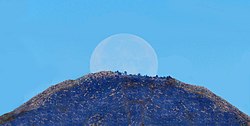
Concerning the lunar month every bit viewed from Earth, the lunar phase or Moon phase is the shape of the Moon's directly sunlit portion, which can exist expressed quantitatively using areas or angles or described qualitatively using the terminology of new moon, waxing crescent, first quarter, waxing gibbous, total moon, waning gibbous, terminal quarter and waning crescent.
The lunar phases gradually modify over a synodic month (about 29.53 days) every bit the Moon'due south orbital positions around Earth and Earth around the Sun shift. The visible side of the moon is variously sunlit, depending on the position of the Moon in its orbit. Thus, this face's sunlit portion tin can vary from 0% (at new moon) to 100% (at total moon). Each of the four "intermediate" lunar phases (see beneath) is approximately 7.iv days, with +/- nineteen hours in variation (half dozen.58–8.24 days) due to the Moon's orbit's elliptical shape.
Phases of the Moon [edit]

Animation showing progression of moon stage.
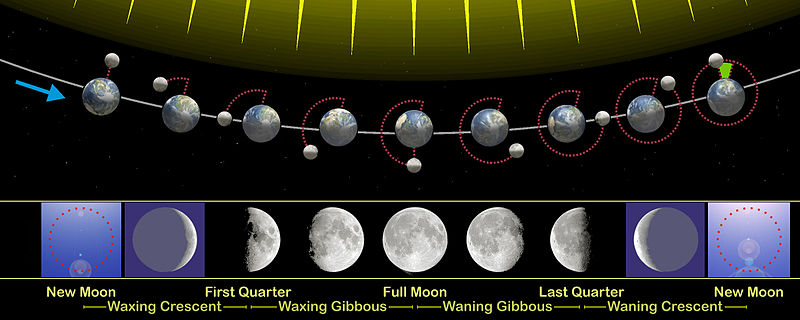
The phases of the Moon as viewed looking south from the Northern Hemisphere. Each phase would exist rotated 180° if seen looking northward from the Southern Hemisphere. The upper role of the diagram is not to scale, as the Moon is much further from Earth than shown hither.
There are four chief lunar phases: the new moon, start quarter, total moon, and concluding quarter (as well known as third or terminal quarter), when the Moon's ecliptic longitude is at an bending to the Sun (as viewed from the center of the Earth) of 0°, 90°, 180°, and 270°, respectively.[ane] [a] Each of these phases appears at slightly different times at unlike locations on Earth. During the intervals between principal phases are intermediate phases, during which the Moon's credible shape is either crescent or gibbous. On boilerplate, the intermediate phases last one-quarter of a synodic calendar month, or 7.38 days.[b] The descriptor waxing is used for an intermediate phase when the Moon's apparent shape is thickening, from new to a total moon, and waning when the shape is thinning. The longest duration between full moon to new moon (or new moon to full moon) lasts nearly xv days and 14+ 1⁄2 hours, while the shortest duration betwixt full moon to new moon (or new moon to full moon) lasts but about xiii days and 22+ 1⁄2 hours.
- A new moon appears highest on the summer solstice and everyman on the winter solstice.
- A first quarter moon appears highest on the spring equinox and everyman on the fall equinox.
- A full moon appears highest on the winter solstice and lowest on the summer solstice.
- A last quarter moon appears highest on the autumn equinox and everyman on the spring equinox.
| Moon phase | Illuminated portion | Visibility | Average moonrise time[c] | Culmination time (highest point) | Average moonset fourth dimension[c] | Illustration | Photograph (view from Northern Hemisphere) | Photograph (view from Southern Hemisphere) | ||
|---|---|---|---|---|---|---|---|---|---|---|
| Northern Hemisphere | Southern Hemisphere | Northern Hemisphere | Southern Hemisphere | |||||||
| New Moon | (lit past earthshine but) | Invisible (too close to Sunday) except during a solar eclipse | half-dozen am | Noon | 6 pm |  | | | | |
| Waxing crescent | Right side, (0%–50%) lit disc | Left side, (0%–50%) lit disc | Late morning to mail-dusk | 9 am | 3 pm | 9 pm |  |  | 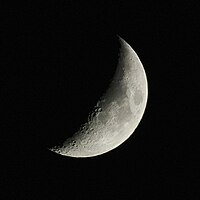 | |
| Showtime quarter | Right side, l.1% lit disc | Left side, 50.ane% lit disc | Afternoon and early on night | Noon | 6 pm | Midnight |  |  |  | |
| Waxing gibbous | Right side, (50%–100%) lit disc | Left side, (50%–100%) lit disc | Late afternoon and nigh of night | 3 pm | 9 pm | 3 am |  |  | 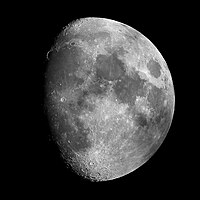 | |
| Full Moon | | Dusk to sunrise (all night) | 6 pm | Midnight | 6 am |  | | 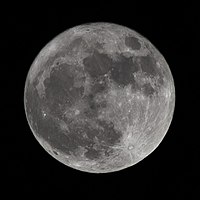 | | |
| Waning gibbous | Left side, (100%–50%) lit disc | Right side, (100%–50%) lit disc | Nigh of dark and early morning | 9 pm | three am | 9 am | | | 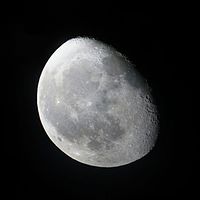 | |
| Last quarter | Left side, 50.one% lit disc | Right side, fifty.one% lit disc | Belatedly dark and morning | Midnight | 6 am | Apex | | | 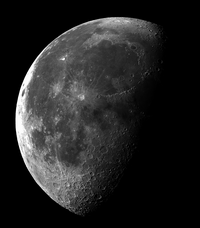 | |
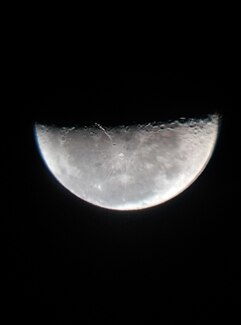
| Waning crescent | Left side, (l%–0%) lit disc | Right side, (fifty%–0%) lit disc | Pre-dawn to early afternoon | 3 am | nine am | 3 pm | | |  | |



This video provides an illustration of how the Moon passes through its phases – a production of its orbit, which allows different parts of its surface to be illuminated by the Dominicus over the course of a month. The camera is locked to the Moon as Earth rapidly rotates in the foreground.
Non-Western cultures may employ a different number of lunar phases; for case, traditional Hawaiian culture has a total of 30 phases (1 per day).[2]
Waxing and waning [edit]
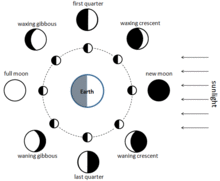
Diagram of the Moon's phases: The Earth is at the center of the diagram and the Moon is shown orbiting.
When the Sun and Moon are aligned on the aforementioned side of the Earth, the Moon is "new", and the side of the Moon facing Earth is not illuminated by the Dominicus. As the Moon waxes (the amount of illuminated surface equally seen from World is increasing), the lunar phases progress through new moon, crescent moon, first-quarter moon, gibbous moon, and full moon. The Moon is so said to wane as it passes through the gibbous moon, third-quarter moon, crescent moon, and dorsum to new moon. The terms old moon and new moon are non interchangeable. The "onetime moon" is a waning sliver (which eventually becomes undetectable to the naked eye) until the moment it aligns with the Sun and begins to wax, at which signal it becomes new once again.[three] Half moon is often used to mean the outset- and 3rd-quarter moons, while the term quarter refers to the extent of the Moon's cycle effectually the Globe, not its shape.
When an illuminated hemisphere is viewed from a sure angle, the portion of the illuminated area that is visible will take a two-dimensional shape every bit defined by the intersection of an ellipse and circle (in which the ellipse'due south major axis coincides with the circle's diameter). If the half-ellipse is convex with respect to the half-circle, then the shape will be gibbous (bulging outwards),[4] whereas if the half-ellipse is concave with respect to the half-circumvolve, then the shape will be a crescent. When a crescent moon occurs, the miracle of earthshine may be apparent, where the dark side of the Moon dimly reflects indirect sunlight reflected from Globe.[v]
Orientation past latitude [edit]
In the Northern Hemisphere, if the left (east) side of the Moon is dark, and so the bright office is thickening, and the Moon is described every bit waxing (shifting toward full moon). If the correct (due west) side of the Moon is dark, then the bright part is thinning, and the Moon is described every bit waning (past total and shifting toward new moon). Assuming that the viewer is in the Northern Hemisphere, the correct side of the Moon is the part that is always waxing. (That is, if the right side is dark, the Moon is becoming darker; if the right side is lit, the Moon is getting brighter.)
In the Southern Hemisphere, the Moon is observed from a perspective inverted, or rotated 180°, to that of the Northern and to all of the images in this article, then that the contrary sides appear to wax or wane.
Closer to the Equator, the lunar terminator will appear horizontal during the morn and evening. Since the to a higher place descriptions of the lunar phases only utilise at middle or high latitudes, observers moving towards the tropics from northern or southern latitudes will see the Moon rotated anti-clockwise or clockwise with respect to the images in this article.
The lunar crescent can open up upward or downward, with the "horns" of the crescent pointing upward or down, respectively. When the Sun appears in a higher place the Moon in the sky, the crescent opens downward; when the Moon is in a higher place the Dominicus, the crescent opens upwardly. The crescent Moon is most clearly and brightly visible when the Dominicus is beneath the horizon, which implies that the Moon must exist to a higher place the Dominicus, and the crescent must open up upward. This is therefore the orientation in which the crescent Moon is most often seen from the tropics. The waxing and waning crescents await very similar. The waxing crescent appears in the western sky in the evening, and the waning crescent in the eastern heaven in the morning.
Earthshine [edit]

An overexposed photograph of a crescent Moon reveals earthshine and stars.
When the Moon as seen from Earth is a sparse crescent, World as viewed from the Moon is almost fully lit by the Sunday. Often, the dark side of the Moon is dimly illuminated by indirect sunlight reflected from Earth, just is bright enough to be easily visible from Earth. This miracle is called earthshine and sometimes picturesquely described as "the old moon in the new moon's arms" or "the new moon in the old moon's artillery".
Calendar [edit]
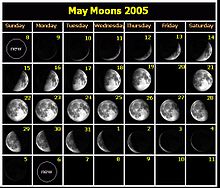
May–June 2005 agenda of lunar phases
The Gregorian month, which is 1⁄12 of a tropical year, is about 30.44 days, while the cycle of lunar phases (the Moon's synodic period) repeats every 29.53 days on average.[6] The shortest wheel was on 20 July 1978 and it just took 29.27 days to complete the cycle.[ citation needed ] The longest bicycle will have place on xix January 2049 and information technology will take 29.83 days.[ commendation needed ] Therefore, the timing of the lunar phases shifts by an average of most one day for each successive month. (A lunar twelvemonth lasts about 354 or 355 days.)
Photographing the Moon's phase every day for a calendar month (starting in the evening afterward sunset, and repeating roughly 24 hours and l minutes after, and catastrophe in the morning time before sunrise) and arranging the series of photos on a calendar would create a blended paradigm like the instance calendar (May viii – June half dozen, 2005) shown on the left. May 20 is blank because a moving picture would exist taken before midnight on May xix and the next after midnight on May 21.
Similarly, on a agenda list moonrise or moonset times, some days will appear to exist skipped. When moonrise precedes midnight one night, the next moonrise will follow midnight on the adjacent night (and so too with moonset). The "skipped day" is merely a feature of the Moon's eastward movement in relation to the Sunday, which at most latitudes, causes the Moon to rise afterwards each solar day. The Moon follows a predictable orbit every calendar month.
Calculating phase [edit]

Each of the iv intermediate phases lasts approximately 7 days (seven.38 days on average), but varies ±11.25% due to lunar apogee and perigee.
The number of days counted from the time of the new moon is the Moon's "age". Each complete cycle of phases is called a "lunation".[vii]
The approximate age of the Moon, and hence the gauge stage, can exist calculated for whatsoever date by computing the number of days since a known new moon (such every bit Jan ane, 1900 or August xi, 1999) and reducing this modulo 29.53059 days (the mean length of a synodic calendar month).[half-dozen] [d] The divergence between two dates can be calculated past subtracting the Julian day number of one from that of the other, or there are simpler formulae giving (for example) the number of days since Dec 31, 1899. However, this calculation assumes a perfectly circular orbit and makes no assart for the time of twenty-four hours at which the new moon occurred and therefore may be incorrect by several hours. (It also becomes less authentic the larger the difference betwixt the required appointment and the reference date). It is authentic enough to utilise in a novelty clock awarding showing lunar phase, but specialist usage taking business relationship of lunar apogee and perigee requires a more elaborate calculation.
Effect of parallax [edit]
The World subtends an angle of about 2 degrees when seen from the Moon. This ways that an observer on Earth who sees the Moon when it is close to the eastern horizon sees it from an angle that is about 2 degrees different from the line of sight of an observer who sees the Moon on the western horizon. The Moon moves near 12 degrees around its orbit per day, so, if these observers were stationary, they would see the phases of the Moon at times that differ by well-nigh one-sixth of a twenty-four hour period, or 4 hours. But in reality, the observers are on the surface of the rotating Earth, so someone who sees the Moon on the eastern horizon at one moment sees it on the western horizon about 12 hours later. This adds an oscillation to the apparent progression of the lunar phases. They appear to occur more slowly when the Moon is high in the sky than when it is below the horizon. The Moon appears to move jerkily, and the phases do the same. The amplitude of this oscillation is never more than than about four hours, which is a small fraction of a month. Information technology does not have whatsoever obvious consequence on the advent of the Moon. It does however affect authentic calculations of the times of lunar phases.
Misconceptions [edit]
Orbital period [edit]
It tin exist confusing that the moon'south orbital flow is 27.3 days while the phases consummate a cycle one time every 29.5 days. This is due to the Earth's rotation around the Sun. The Moon orbits the Earth thirteen.four times a year, but simply passes between the Earth and Dominicus 12.iv times.
Eclipses [edit]
The lunar stage depends on the Moon's position in orbit around the Earth and the Globe's position in orbit around the sun. This animation (non to scale) looks downwards on Earth from the north pole of the ecliptic.
It might exist expected that once every month, when the Moon passes betwixt Earth and the Lord's day during a new moon, its shadow would fall on Earth causing a solar eclipse, but this does not happen every calendar month. Nor is it truthful that during every full moon, the World's shadow falls on the Moon, causing a lunar eclipse. Solar and lunar eclipses are not observed every month because the plane of the Moon's orbit effectually the Globe is tilted past near 5° with respect to the plane of World's orbit effectually the Sun (the plane of the ecliptic). Thus, when new and full moons occur, the Moon commonly lies to the north or s of a directly line through the Earth and Sunday. Although an eclipse can merely occur when the Moon is either new (solar) or total (lunar), it must also be positioned very almost the intersection of Globe'southward orbital airplane well-nigh the Sun and the Moon's orbital plane about the World (that is, at 1 of its nodes). This happens about twice per year, and so at that place are between four and seven eclipses in a calendar year. Most of these eclipses are partial; total eclipses of the Moon or Sun are less frequent.
Run across likewise [edit]
- Blue moon – Mutual name for ane of the full moons in a yr with thirteen full moons
- Lunar upshot – Unproven proposal of influence of lunar bicycle on terrestrial creatures
- Lunar month – Fourth dimension between successive new moons. (Also known as a "lunation".)
- Lunar ascertainment – Methods and instruments used to observe the moon
- Planetary stage – Menstruum of time during which a planet'south surface reflects specific amounts of sunlight from the perspective of a given signal in infinite
- Planetshine – Illumination by reflected sunlight from a planet
- Tide – Rise and fall of the sea level under astronomical gravitational influences
- Week – Time unit equal to seven days
- Month – Unit of time about every bit long the orbital period of the Moon
Footnotes [edit]
- ^ The quarter phases happen when the observer–Moon–Dominicus angle is xc°, besides known equally quadrature. This is non the same equally a right bending, but the divergence is very slight.
- ^ Their durations vary slightly considering the Moon's orbit is somewhat elliptical, so its orbital speed is not constant.
- ^ a b As with sunrise and sunset, there are seasonal variations in the time of moonrise and moonset.
- ^ Lunar months vary in length most the mean by up to 7 hours in any given year. In 2001, the synodic months varied from 29d 19h 14m in January to 29d 07h 11m in July.[8]
References [edit]
- ^ P. Kenneth Seidelmann, ed. (1992). Explanatory Supplement to the Astronomical Almanac. p. 478.
- ^ "Hawaiian Moon Names". Imiloa, Hilo Attractions. Archived from the original on 2014-01-02. Retrieved 2013-07-08 .
- ^ "Free Astronomy Lesson seven - The Phases of the Moon". Synapses.co.u.k. . Retrieved 2015-12-28 .
- ^ Origin: 1350–1400; Middle English < Latin gibbōsus humped, equivalent to gibb "(a) hump" + -ōsus "-ous"; "Gibbous". Dictionary.com.
- ^ Leah Asmelash and David Allan (thirty July 2019). "A black moon is coming on July 31. Hither's what that means". CNN.
- ^ a b P. Kenneth Seidelmann, ed. (1992). Explanatory Supplement to the Astronomical Annual. p. 577.
For convenience, it is common to speak of a lunar yr of twelve synodic months, or 354.36707 days.
(which gives a hateful synodic month as 29.53059 days or 29 days 12 hours 44 minutes and three seconds) - ^ "Phases of the Moon and Percent of the Moon Illuminated". aa.usno.navy.mil . Retrieved 2018-02-12 .
- ^ "Length of the Synodic Calendar month: 2001 to 2100". astropixels.com. 8 November 2019.
Bibliography [edit]
- Buick, Tony; Pugh, Philip (2011). How to Photograph the Moon and Planets with Your Digital Camera. Springer. ISBN978-ane-4419-5828-0.
- Kelley, David H.; Milone, Eugene F. (2011). Exploring Ancient Skies: A Survey of Ancient and Cultural Astronomy (2d ed.). Springer. ISBN978-1-4419-7624-half-dozen.
- Kutner, Marc Fifty. (2003). Astronomy: A Physical Perspective . Cambridge University Printing. p. 435. ISBN978-0-521-52927-3.
- Lynch, Mike. Texas Starwatch. Voyageur Press. ISBN978-i-61060-511-iii.
- Naylor, John (2002). Out of the Blue: A 24-Hour Skywatcher's Guide. Cambridge Academy Printing. ISBN978-0-521-80925-2.
- Ruggles, Clive L. N. (2005). Ancient Astronomy: An Encyclopedia of Cosmologies and Myth. ABC-CLIO. ISBN978-i-85109-477-vi.
External links [edit]
Fred Espenak, 6 Millennium Itemize of Phases of the Moon: Moon Phases from -1999 to +4000 (2000 BCE to 4000 CE).
Source: https://en.wikipedia.org/wiki/Lunar_phase
0 Response to "A Week After the the Full Moon the Moon Looks Like a Semicircle Again Thi Phase Is Called What"
Post a Comment